0
Contact Us

New Zealand goes to the polls in just over 5 weeks. Tax and tax-adjacent policy is front and centre leading into the election. While National, ACT and New Zealand First largely favour continuity, Labour, the Green Party, Te Pāti Māori and Opportunity are each proposing changes that would extend, if not profoundly reshape, parts of the tax base. The left-bloc / right-bloc contrast has never been starker.
It is beyond question that if the left-bloc forms the next government, the tax system will undergo structural change. The extent and significance of that change will turn on the outcome of coalition negotiations. Experience tells us that in tax, as in other policy areas, the realities of gluing together a credible and stable coalition government quickly put paid to chimerical extremes.
For businesses, investors and individuals alike, understanding what each party is proposing, and how realistic those proposals would be in the context of coalition talks, is an important part of planning for the years ahead.
We have created a table highlighting the parties’ positions across nine key tax and tax-adjacent policy areas:
Personal income tax thresholds
Capital gains tax, land tax and property investment settings
Wealth and inheritance tax
Corporate and business tax
Business investment incentives and small business support
KiwiSaver, retirement savings and Superannuation
GST
Tax integrity and Inland Revenue enforcement
Other targeted tax and economic policies
The  and
and  signs in the table illustrate our assessment of policies that are respectively capable or incapable of surviving coalition negotiations, with the
  sign indicating a “maybe”.
View our table below - click to enlarge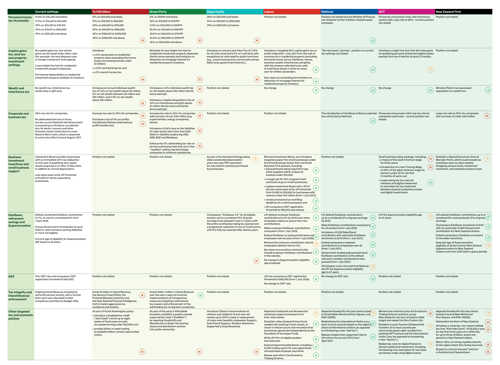
A diminished major party is still a major party, so when the rubber hits the road Labour will be in the driving seat. We see very little in the minor left-bloc parties’ tax policies with a realistic prospect of implementation under a Labour-led coalition government. Rather, we expect the minor left-bloc parties would broadly back Labour’s proposed capital gains tax, putting aside their wealth, land and other mooted regimes. Labour’s targeted design will be the starting point for negotiations, with the debate centring on scope.
Our pick is that the minor left-bloc parties may have sufficient leverage to promote a broader based capital gains tax than that proposed by Labour, extending beyond commercial and residential property (other than the main home) to capture, for example, gains on the sale of businesses.
Labour’s specific small business commitments are also likely to hold, including replacing Investment Boost with a higher low-value asset write-off threshold for smaller businesses. Neither the Green Party nor Te Pāti Māori have taken a position on Investment Boost or other small business measures proposed by Labour, so the detail, such as timing, threshold or scope, could still shift in coalition talks even if the general direction looks settled.
By contrast, National, ACT and New Zealand First have released comparatively little detailed tax policy for this election, though the specific commitments they have made point toward broadly similar priorities.
National and ACT have each campaigned on a "no new taxes" stance and proposed their own mechanism for redirecting the International Visitor Levy toward local councils rather than introducing a new "bed tax". Together, these signal, at minimum, a preference for holding current tax settings steady while directing more support toward tourism infrastructure.
Where New Zealand First's support is required to form a government, the party's real leverage is likely to sit around retirement settings.
National and ACT both are both campaigning on lifting the superannuation eligibility age to 67, but New Zealand First would keep the age at 65 while restricting eligibility to New Zealand citizens. This will be a key point of difference to be resolved in negotiations should the right-bloc have the numbers following 7 November.
With both major parties backing higher KiwiSaver contributions, one thing seems certain regardless of the election outcome: employers should brace for rising KiwiSaver costs. Under current settings, the default combined contribution rate is 7%, due to rise to 8% from 1 April 2028. National and Labour have both proposed to lift the default employer contribution to 6% by 2032, make employer contributions compulsory for all workers from 1 July 2028, and extend KiwiSaver contributions to employees over 65.
Labour goes further, proposing to ban total remuneration structures that bury employer KiwiSaver contributions inside an employee's headline salary - a change that would require employers who use those structures to rework remuneration packages well before 2028.
Either way, it seems that businesses should start budgeting for higher payroll costs now and watch for the final rate, timing and scope once coalition talks conclude.
If you would like to discuss how any of the tax policy proposals may affect you or your clients, please get in touch with one of our experts in Simpson Grierson’s tax team.
Special thanks to Angela Liu for her assistance in writing this article.


