0
Contact Us

The Committee of the Whole stage for the PB and NEB concluded on 25 August 2026.
Two Government amendment papers (numbers 709 and 710) and further amendments tabled in the House made significant changes to the Bills.
The Bills are now awaiting third reading and Royal assent.
In this article, we identify the key changes to the Bills reported from the Committee of Whole House, including their impact on the transition from the Resource Management Act 1991 (RMA) to the new statutory regime.
Our comments cover the following topics:
• Timing and transition
• Changes to core provisions in the “Foundations” part of each Bill
• Regional spatial plans
• Transitional consenting
• Fast-track changes
• Iwi and hapū interests
• Other changes.
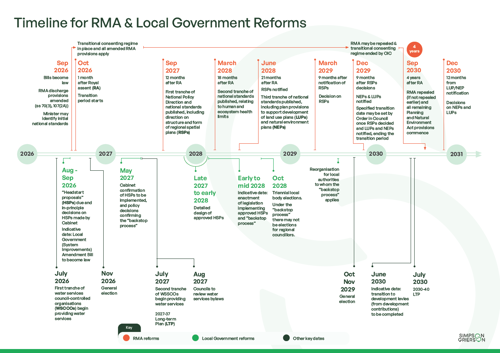
The Bills will not immediately repeal and replace the RMA on commencement. Instead, a transition period will begin one month after Royal assent, during which the RMA will continue to apply (with some modifications, particularly to consenting processes) while national instruments are issued and regional spatial plans (RSP), land use plans (LUP), and natural environment plans (NEP) are progressively prepared, notified, and decided.
New components from a timing perspective include:
a four-year commencement backstop, with all provisions in the Acts that are not already live coming into force four years after Royal assent; and
a new suite of transitional amendments to the Fast-track Approvals Act 2024 (FTAA), many of which commence the day after Royal assent (discussed further below).
The Bills’ transitional arrangements continue to provide for the Governor-General to identify a “specified transition date” (or dates, if the timing is different from some regions or areas) once all RSPs are decided and all proposed LUPs and NEPs are notified. From the specified transition date, the RMA and instruments made under it will cease to apply.
The timeline below picks up the new four-year commencement backstop and the anticipated start of the transition period in late October 2026, alongside other local government reform timeframes and key dates:
Goals and key instruments
The second reading version of each Bill required everyone exercising or performing functions or powers under a Bill to seek to achieve its stated goals, with some exceptions. That duty has been shifted and consequently narrowed. It is now the key instruments established under each Bill that must seek to achieve the statutory goals [cl 11, both Bills].
The key instruments remain (in the specified top to bottom hierarchy):
national policy direction
national standards
RSPs
LUPs/NEPs.
The change emphasises the policy intent that direct consideration of goals should decrease as decisions drop down through the hierarchy of key instruments and into decisions on planning consents and natural resource permits.
This is reflected in corresponding changes to decision-maker discretion to consider goals directly. Decision-makers for all matters (except the making of national policy direction) may now only directly consider goals where a higher-order instrument is silent, significantly uncertain, or irreconcilably conflicts with another higher-order instrument in relation to a goal [cl 12, both Bills].
A new clause also clarifies the order in which some key instruments must be considered, providing that a decision-maker on a planning consent or natural resource permit must “first consider” the relevant LUP/NEP and national standards [cl 12A, both Bills]. The intent appears to be to confirm that the assessment of key instruments starts at the lowest rung of the statutory hierarchy (the LUP/NEP) and that national standards must also be considered (leap-frogging the RSP in the statutory hierarchy), notwithstanding that would ordinarily only be possible if the LUP/NEP and the RSP didn’t address a particular matter.
The scope of the NEB’s biodiversity goal has been narrowed and made less ambitious. Rather than requiring “no net loss” in indigenous biodiversity, the goal now focuses on the protection of “significant” indigenous biodiversity [NEB cl 11(1)(d)].
The purpose of national policy direction has been restated but remains focused on two components:
to particularise all the goals; and
to direct how the goals are to be achieved, including by identifying and providing for the resolution of conflict between them, as far as is practicable [PB cl 47, NEB cl 71].
Initial indications of how these components might be addressed appear in the illustrative National Policy Direction that was launched for public consultation on 25 August 2026 (the date the Committee of the Whole House debate concluded on the Bills), with feedback sought by 16 October 2026.
Effects
The PB now requires any decision-maker considering the effects of an activity to disregard effects on outstanding natural landscapes or features (ONF/L), or areas of high natural character, where an activity is located more than three nautical miles from the landward boundary of the coastal marine area [PB cl 14(1A)].
A further change confirms that this does not restrict the consideration or management of areas of high natural character in the coastal environment that are within three nautical miles from the landward boundary of the coastal marine area. These changes will have a significant impact on coastal ONF/L, such as in the Marlborough Sounds.
Within the NEB, the clause on considering certain effects of activities [cl 14] - including the positive effects of enabling activities, effects on natural resources, and the effects of natural hazards associated with the use or protection of natural resources - has been deleted. The clause on considering adverse effects of activities [cl 15] remains, leaving some uncertainty over whether the cl 14 effects are still relevant.
National standards may specify the circumstances in which particular effects are to be managed under the PB or the NEB, which will help to avoid uncertainty or duplication between the two [PB cl 52(1)(d), NEB cl 77 (1)(d)].
New provisions refine the RSP content that may be determined through national instruments:
national standards may state requirements relating to the content of RSPs, including objectives, actions, policies, methods, or other provisions, that must be incorporated [PB cl 52(3C), NEB cl 77(3C)];
national standards may also require the inclusion of standardised plan provisions in RSPs - with flexibility for RSP decision-makers only if authorised by national standards (but excluding any general authority to amend standardised plan provisions) [PB cl 67BA].
Spatial plan committees will also be required to publicly notify any review of a RSP. Following completion of the review, the committee must publish a report explaining the review and stating whether amendments are recommended. Where recommended, local authorities must move to amend the plan as soon as reasonably practicable [PB cl 74AAA and 74A].
The PB amends the operation of the RMA during the transition period [PB Sch 11, Part 2], particularly in relation to consenting. Adjustments made will improve certainty and better integrate the amendments with the RMA regime.
Consent authorities must disregard effects when considering consent applications for “district land use activity” under new section 104(1A) of the RMA. The previous requirement to disregard “the internal layout of a building or the external layout of any building on a site if the effects of the external layout remain within the boundaries of the site” has been recast as:
any of the following where they relate to residential activities (except in relation to the protection of historic heritage):
(i) the area of glazing
(ii) the presence or absence of balconies
(iii) the outdoor living space
(iv) the internal layout
(v) the size of a residential unit
(vi) the size of landscaped areas (except in relation to
permeability).
This amendment has not been carried over into the list of effects outside the scope of the PB in cl 14, which still uses the earlier internal/external layout language. This may a disconnect that is addressed by future amendments before the end of the transition period to the new Acts.
The duty to disregard effects is also no longer limited to the assessment of effects under s 104(1)(a); it can now also extend to the policy assessment under section 104(1)(b) and other aspects of s 104(1) where relevant.
The excluded effects are clearly now out of scope for notification decisions, when determining a non-complying activity, and for the assessment of environmental effects required for district land use activities (s 104, s 95D, s 95E, s 104D, and Schedule 4, cl 7 of the RMA). The tools in new ss 76A and 104AA of the RMA (recommended by the Select Committee) for dealing with out-of-scope effects will be important to the implementation of the clarified regime by local authorities.
It is possible that excluded effects may still be in scope for consideration for subdivision consents, as "district land use activity" and "district land use consent" remain undefined. The RMA’s existing distinction between land use and subdivision activities arguably continues to apply [RMA ss 2 and 87].
A new clause lets the Minister flag a national standard made under the Bills as an "initial national standard" so it can be taken into account under the still-operating RMA during the transition period. It cannot be used to amend an RMA plan or bypass the normal plan change process [RMA s 104(1)(b)(va), PB Sch 1, cl 6 and Sch 11, Part 2].
There are immediate changes to ss 70 and 107 of the RMA. The consent authority now has discretion to grant a permit that allows all effects described in s 107(1), such as the production of conspicuous films, scums or foams, conspicuous changes of colour or visual clarity, and emission of objectionable odours. Similar changes are also made to the permissible scope of discharge rules in regional plans under s 70 of the RMA [PB Sch 11, Part 1]. These changes apply both to proposed plans notified, or applications lodged, after the PB is enacted and to earlier proposed plans or applications that are subject to appeals or ongoing proceedings.
A new transitional regime clarifies which version of the law applies and accommodates the eventual move away from RMA approvals.
Amendments to the FTAA are spread across three timeframes:
The day after Royal assent, new Part 3 is inserted into Schedule 1 of the FTAA. This sets out how referral applications, substantive applications, and various kinds of fast-track approvals are to be determined during the shift to the new planning regime [PB Sch 11, Part 1].
One month after Royal assent, Schedule 5 of the FTAA is amended so environmental assessment and mitigation information provided for a fast-track application submitted after the transition period has started does not need to cover the effects excluded under section 104(1A) of the RMA [PB Sch 11, Part 2A].
On a date to be set by Order in Council, a raft of changes will be made to the FTAA to integrate it with the new Acts. In particular, Schedule 5 will be replaced with new content that relates to approvals under the Acts rather than the RMA [PB Sch 11, Part 4].
The main impact of these amendments is that they determine the version of the RMA that will be considered (in the context of FTAA decision-making) during the transition period. Applications made after the transition period commences will generally be considered against the modified version of the RMA, including the duty to disregard the classes of effects in new s 104(1A).
How it WORKS: | |
Application lodged before the transition period starts | Both referral and substantive applications continue to be processed and determined under the FTAA and the RMA as they stood at the time the application was made [FTAA Sch 1, Part 3, cl 17 and 19]. |
Application lodged and determined during the transition period | This scenario is not expressly addressed in the transitional provisions. However, it is likely that the position will be the same as for applications that are subject to cl 18 and 20 (see below), as amendments to the FTAA in Part 4 of Schedule 11 of the PB are unlikely to have been made. |
Application lodged but not determined during the transition period | The FTAA applies as it stood immediately before Part 4 of Schedule 11 of the PB amends it. The RMA, as referred to in the FTAA, applies as in force on the day the application was lodged [FTAA Sch 1, Part 3, cl 18 and 20]. Out-of-scope effects will need to be disregarded in accordance s 104(1A) of the RMA and FTAA applications will not need to include them in an assessment of effects on the environment (for a resource consent) or information on the effects of a project or work (for a notice of requirement). |
What happens once the Panel grants approval under this transitional pathway? | Where cl 20 applies to FTAA approvals:
|
We discussed the Bills’ implications for Māori in our previous article. Further significant amendments have been made in this area.
Treaty settlement redress
The Bills retain the new compliance mechanism that is intended to allow settlement redress or other arrangements to operate with the same, or equivalent, effect as under the RMA. These provisions are adjusted to provide that a person subject to the duty must comply with it in accordance with relevant national standards or regulations [cl 10, both Bills].
Te Ture Whaimana
A new clause in both Bills sees Te Ture Whaimana (the Vision and Strategy for the Waikato and Waipā Rivers) recognised as the primary direction-setting document for the Waikato and Waipā Rivers and the catchment activities that affect them. The framework also sets out how it is intended to interact with instruments made under the Bills [cl 10A, both Bills].
In practical terms, Te Ture Whaimana is treated as forming part of any relevant RSP, LUP or NEP without needing to go through the usual plan-change process, and it prevails over any inconsistent provision in a national instrument, regulation, plan, water services standard, or water conservation order.
Where Te Ture Whaimana applies:
The relevant decision maker cannot review or amend Te Ture Whaimana through the ordinary plan review process;
The rest of the RSP, LUP or NEP must give effect to Te Ture Whaimana;
Once the RSP, LUP or NEP is operative, any inconsistency with Te Ture Whaimana must be resolved as quickly as possible, and Te Ture Whaimana prevails over the plan in the meantime;
No amendment can be made to the relevant RSP, LUP or NEP if it would create a new inconsistency with Te Ture Whaimana; and
A plan provision that gives effect to Te Ture Whaimana by imposing stricter standards than a national instrument, water services standard, or water conservation order, will prevail over that less stringent instrument.
Decision-makers exercising other functions relating to the Waikato and Waipā rivers or catchment activities affecting them must now give Te Ture Whaimana particular regard. The clause in both Bills is non-exhaustive and sits alongside, rather than replaces, the separate Treaty settlement obligations elsewhere in the Bills.
Iwi participation agreements
The Bills no longer accommodate existing or proposed Mana Whakahono a Rohe agreements developed and entered into under the RMA, which cease to have legal effect on the day after the Bills received Royal assent [PB Sch 1, Part 1, cl 21].
Instead, iwi authorities may at any time request local authorities to enter into an iwi participation agreement. Only iwi authorities can initiate this request, though hapū may join as parties [PB cl 198A, NEB cl 237A].
An iwi participation agreement may:
specify how iwi authorities (including hapū) will participate in processes for iwi authority participation provided for under the two Acts;
specify how iwi authorities (including hapū) and the relevant local authorities will engage on any other relevant matters under the Acts necessary to implement Treaty settlement redress; and
include provisions relating to permitting or consenting processes under the Acts, where the iwi authority (including hapū) is an affected party or a qualifying person, or to provide for specified Treaty settlement redress matters.
A local authority may decline to agree to the inclusion of any proposed provisions in the agreement. Iwi authorities can withdraw from an agreement at any time on written notice, and local authorities can seek to renegotiate their own involvement [PB cl 198D, NEB cl 237D]. The distinction here is important: iwi authorities may step away from an iwi participation agreement at any time, while local authorities may only do so with the agreement of the other participating parties.
There are other changes scattered through the Bills. We discuss some of the more significant ones below.
Definitions
The following definitional changes are notable:
The "best practicable option" test for discharges of contaminants now also requires regard to minimising adverse effects on people, not just on natural resources [NEB cl 3].
The definition of "built environment" is amended so the list of included matters becomes exhaustive [PB cl 3].
The definition of "long-lived infrastructure" is amended to include structures, facilities, or infrastructure for water storage and distribution [NEB cl 3].
The NEB’s "natural resource use activity" definition is amended to include “the capacity of air or water to assimilate the discharge of a contaminant” rather than the previous “the discharge of a contaminant into air or water” [NEB cl 3]. The change in focus from a positive activity to an attribute of the receiving environment may have unanticipated consequences.
The PB now defines a "qualifying person" rather than the previous “qualifying resident” in terms that cover classes of person in relation to both districts and regions, rather than districts only [PB cl 3]. This definition is relevant to notification processes and aspects of iwi participation agreements.
Environmental limits and caps on resource use
The concept of a "cap on resource use" has been removed entirely from the NEB, including the clause that allowed a cap to be set for resources subject to an environmental limit. However, regional councils retain the ability to propose "controls on land use or inputs" through an action plan and set them through a NEP, a route that could, in practice, achieve much the same result [NEB cl 62 and 64].
Ministerial discretion to authorise activities that breach, or are likely to breach, specified environmental limits has also been adjusted. Clause 79 of the NEB now imposes a net public benefit test, which must be assessed by considering the public benefits and public costs of authorising the activities. Formerly, this provision required the Minister to be satisfied that public benefits outweigh harms to relevant aspects of ecosystem health or human health, and community needs and aspirations.
Fishing and aquaculture
A new clause means that instruments made under either Bill cannot control fishing within the coastal marine area. Outside that area, any fishing restrictions that do apply won't affect customary non-commercial fishing carried out under existing fishing regulations, Treaty settlement arrangements, or other customary fishing rights (clause 10B, both Bills).
When a council grants a resource permit for an aquaculture activity, it must notify the chief executive of the Ministry responsible for the Fisheries Act 1996 [NEB cl 171A]. The permit does not commence until the Fisheries Act decision-maker has also made its own separate aquaculture decision [NEB cl 177].
Extensions and waivers
Two additional deadlines are now protected and cannot be extended or waived [PB cl 286, NEB cl 320]:
the time period for the publication of decisions on independent hearings panel recommendations on a draft RSP, proposed LUP, or proposed NEP; and
transitional timeframes for key instruments and extension of the duration of certain existing resource consents.
Competitive urban land markets and specific plan change processes
In addition to the matters arising from Government amendment papers, tabled amendments introduced during the debate on the Bills related to:
the appointment and role of a new statutory officer to monitor the competitiveness of urban land markets [PB cl 188A and 188B, 281, and Schedule 10A]; and
the progress of specific RMA planning instruments, namely the Manawatū-Whanganui Regional Council One Plan and Waikato Regional Council’s Plan Change 1 [PB Sch 1, Part 1, cl 40 and 41 and Sch 11, Part 1 (which inserts new Part 12 into Schedule 12 of the RMA)].
The new statutory officer will be responsible for developing and administering an assessment framework to determine the competitiveness of urban land markets. Where the officer determines that an urban land market is not competitive, the associated report will identify the contributing factors and call out any that relate to the acts or omissions of named local authorities. There will be no right of appeal against the officer’s determinations, although the possibility of challenge through judicial review is expressly preserved.
The amendments addressing specific existing planning instruments are intended to provide for their pragmatic integration with the new planning system, pushing various key implementation dates out to 31 December 2032.
All eyes will now be on the third reading of the Bills and the subsequent giving of Royal assent, which will crystallise the first tranche of transitional timeframes and herald the start of the move away from RMA processes as they are currently known and applied.
Special thanks to Claudia O’Shannessey, Rachael Berry and Tanmeet Singh for their assistance in preparing this article.
Smarter, faster, better? What RMA reform means for infrastructure providers | Simpson Grierson
The Planning and Natural Environment Bills are back, back again | Simpson Grierson