0
Contact Us

The Bills will now proceed to their second reading. They will need to progress quickly, as the Government intends to enact the Bills before the election - requiring them to be passed before 24 September. That timing could be tight given the Amendment Papers have not yet been approved by Cabinet. Hot on the heels of the Committee’s report the Government also announced several Cabinet decisions to amend the Committee’s recommendations. They include a controversial decision to prevent existing Mana Whakahono ā Rohe agreements from transitioning to the new planning system, which is an about turn on the approach signalled in the first reading version of the Bills.[1]
The Environment Select Committee has delivered its Report on the Natural Environment and Planning Bills which are set to replace the Resource Management Act 1991.
The Select Committee retained the overall design of the reforms as well as many elements of the original Bills: including the structure (of having two separate but related Acts), the goals, the excluded effects, the treatment of Treaty settlement obligations and Māori interests, the requirement for regional spatial planning, and regulatory relief. Significant amendments were made in a number of key areas including to the extent of Ministerial control over environmental limits. We unpack ten of the key recommendations of the Select Committee in this article, made in the face of strong opposition from other political parties.
We also outline the new timeline for the Bills’ implementation, alongside the plethora of local government reform occurring at the same time.
Our previous article summarised the first reading version of the Bills. We discussed the overall system architecture, the transition to the new regime, and specific issues across different sectors. Our deep dives into matters of importance for local government, urban development and energy and infrastructure highlighted a number of issues, uncertainties or matters that required further resolution. We explore where those have landed at a high level in this article.
We set out below ten changes of interest that have been recommended by the majority of the Committee. Further amendments to the Bills will be made to reflect the decisions announced by Cabinet. Many elements of the Bills that attracted a large volume of submissions were not recommended to be significantly changed. This includes provisions on regulatory relief, and the way in which the Bills address Treaty settlement obligations and the treatment of Māori interests, which remain largely the same as at first reading.
1. The transition will take longer
The Committee agreed with submitters that the transition timelines as introduced were ‘ambitious and would place particular pressure on local authorities’. It recommended extending the overall transition period by 9 months. The revised sequence (assuming Royal assent in September 2026) would see the transition period end in early 2031 - less than 4.5 years from now.
Key instruments would be developed during the transition period, and the RMA would continue to apply subject to amendments made to it by the PB. Once all land use plans and natural environment plans are notified, a date will be set by Order in Council for the end of the transition period.
The timeline below shows just how much is expected to happen over the next four and a half years.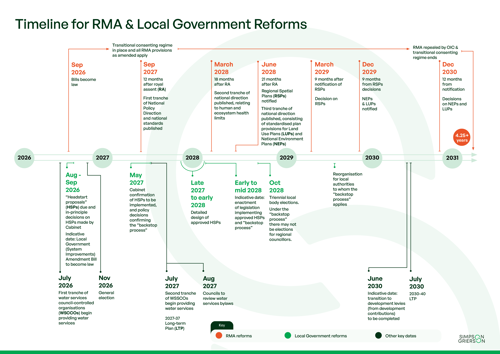 Click to enlarge image
2. A new Planning Bill purpose - enjoyment of land, and tweaked goals
The Committee recommended several refinements to the purpose and goals provisions of both Bills. The purpose of the PB is now ‘to provide for the enjoyment of land by establishing a framework for planning and regulating the use and development of land.’ This was done in response to advice that ‘they are purpose clauses that have no purpose’, albeit no changes were recommended to the NEB purpose.
Changes were also recommended to a number of goals that submitters identified as unclear, to create ‘abundant’ competitive urban land markets, to address infrastructure and environmental enhancement, and to add reference to food and fibre production.
The Committee disagreed with calls for a formal hierarchy between the goals, recommending instead that both Bills be amended to state expressly that the order in which the goals appear does not reflect their relative importance.
The Committee recommended extending the direction that not all goals need to be achieved in all places at all times to anyone exercising functions or powers under the Bills (not just the Minister when making national instruments).
3. Adverse effects of climate change now entirely excluded
Many submitters expressed concern that there was no goal for climate change mitigation, and that there was a lack of integration with the Climate Change Response Act 2002 (see our recent articles about the Government’s National Adaptation Framework and proposed amendments to the Climate Change Response Amendment Bill for more detail on this subject).
In response, the Committee recommended that any adverse effect on climate change of any greenhouse gas emissions that could be increased by an activity is out of scope when considering the effects of an activity (new s 15A of both Bills). This is a significant change, particularly as compared to the current RMA, and existing caselaw. It heralds a return to the exclusion on consideration of greenhouse gas emissions in consenting that applied under the RMA prior to 2020.
Any positive effects of an activity that are associated with avoiding, reducing, removing, or displacing greenhouse gas emissions, are still expressly in scope. While in scope, there remains no goal related to climate change mitigation or renewable energy that might lend support to renewable energy generation activities.
4. Integration between the Bills slightly improved
Coordination between the two Bills was a significant issue raised by submitters. The Parliamentary Commissioner for the Environment warned that the Bills ‘pretend that [the domains] can be treated as distinct and separate matters’ when ‘they cannot in the real world be managed without reference to one another.’ The majority of the Committee nonetheless retained the two-bill structure, concluding it promotes a simpler system with clearer roles.
The Committee recommended two targeted amendments to address this concern. The NEB has been amended to remove the prohibition preventing permit authorities from considering effects regulated under the PB. The PB has also been amended to confirm that natural hazards and contaminated land are not excluded from consideration under the PB, even where those matters are dealt with under other legislation.
5. Environmental limits can be breached in more circumstances
Submissions and advice to the Committee sought a number of changes including to provide a ‘bottom line’ and limit unfettered Ministerial control and intervention in environmental limits.
The Committee recommended introducing a framework under which the Minister can introduce national standards that permit other publicly beneficial activities (not only ‘significant infrastructure’) to breach human or ecosystem health limits in specific circumstances.
This Ministerial power to permit a breach of environmental limits can be used where the following criteria are met:
The public benefits of the activity must outweigh the harm to ecosystem or human health and community needs and aspirations, with specific consideration given to:
the wider implications for natural resource use;
the opportunity costs associated with authorising the activity;
the considerations that informed the setting of the environmental limit.
national standards must clearly identify the relevant activities or classes of activities that are allowed to breach identified limits (to make clear that the clause is invoked, and that councils must follow the standards even if it leads to a breach).
The Committee has also recommended consequential amendments to the obligations of councils, given the difficulties they may have in avoiding or remedying breaches of environmental limits allowed for as a result of national standards.
6. Changes to transitional consenting
As had been proposed when the Bills were first introduced, a transition period will commence 1 month after the Bills receive Royal assent. During the transition period resource consents will continue to be processed under the RMA, as it will be amended by the Bills. This is an element of the Bills that is important, as it will have almost immediate implications.
Two potentially significant amendments have been proposed by the Committee, via changes to the amendments the Bills make to the RMA until its repeal.
First, the Committee has recommend inserting a provision into the RMA that enables district councils to make targeted updates to RMA district plans during the transition period, to remove plan provisions relating to effects that are out of scope of the new Bills without having to use the standard plan change process. This is actually achieved by creating a specific type of permitted activity, where the activity breaches a rule that concerns out of scope effects (new 104AA of the RMA).
Second, the Committee has proposed amending section 104 of the RMA to exclude a different list of matters from consideration as “effects on the environment for any purpose under a district plan”. Those excluded effects do not include landscape effects, which were an excluded effect during transitional consenting in the first reading version of the Bills.
7. Private plan changes can only be rejected on timing grounds
The Committee significantly reduced the grounds on which a council can reject a private request to change a land use plan or natural environment plan, retaining only timing-related grounds, on the basis that requests should be evaluated on their merits once lodged. The “lock-in period”, during which a private plan change request can be rejected on timing grounds, was shortened from two years to 12 months.
8. New allocation methods are removed
The Committee recommended removal of the two proposed new allocation methods introduced by the NEB - comparative permitting and market-based mechanisms (auctions and tenders). Concerns were raised broadly by submitters about the design and function of these methods, and that reforming allocation before resolving Māori freshwater rights and interests could reinforce existing inequalities, be inconsistent with te Tiriti o Waitangi, and prejudice the ability to resolve those rights in the future. The existing allocation framework is retained, including first-in first-served permitting and priority for existing permit holders when permits are replaced.
9. Regional spatial planning and national direction clarifications
The Committee's recommended changes in response to these concerns are modest. The core concerns expressed remain unaddressed, including the 30-year planning horizon, limited appeal rights, short submission windows, and the inability for private parties to initiate changes. The most notable change the Committee has made is a new clause requiring spatial plan committees to consider new information from time to time, including environmental limits, and identify whether and when to initiate a review.
The Committee has added a requirement that each spatial plan committee include at least one member with "knowledge, skill, and experience relating to te ao Māori and Māori development," aligning with the approach taken under the Fast-track Approvals Act 2024.
There is also a new “pre-notification consultation” step, which requires spatial plan committees to consult on a draft regional spatial plan with relevant Ministers, adjacent regional or territorial authorities, iwi authorities, water organisations, infrastructure providers, representatives of the development sector, other sector groups, and the “wider community”, and customary marine title groups. This should help to improve the quality of draft regional spatial plans, but it will also add further pressure to the already tight timeframes for preparing the first regional spatial plans.
The Minister's power to make decisions on Independent Hearing Panel (IHP) recommendations relating to regional spatial plans has been narrowed. The Minister may now only intervene on recommendations relating to nationally significant infrastructure and Crown-owned or Crown-funded assets, and nationally significant matters in the coastal marine area identified in a national instrument.
Clarification of national direction has also been recommended. The Committee found substantial overlap between the roles of national policy direction and national standards and has restructured both to give each a defined purpose. National policy direction is now expressly for high-level policy direction and national standards are confined to providing procedural and regulatory consistency. Notably, national policy direction cannot directly dictate the contents of regional spatial plans, land use plans, or natural environment plans, with only national standards being able to do this.
10. Activity classification and permitted activity tweaks
The Committee recommended that registration requirements for permitted activities be limited to those expressly required by national standards and that most permitted activities should not require registration. The relationship between registered permitted activities and certificates of compliance has also been clarified.
Controlled activities have been reinstated in the NEB primarily in response to concerns from the aquaculture and agriculture sectors, which rely on the certainty this activity class provides. The principles for classifying activities are explicitly guidance, as the actual level and nature of effects will also inform how an activity is classified. There are still no controlled activities under the PB.
Although the Labour party voted for the Bills when they were introduced, and supported them being sent to the Committee, all three opposition parties (Labour, Greens and Te Pāti Māori) have now prepared minority reports which express significant concerns about the Committee’s recommendations. Labour and the Greens oppose the two-bill system, with Labour expressing the view it was deliberately being utilised to remove the “integrated management” approach of the RMA.
All three parties expressed concern about the purpose and goals provisions, arguing that the Bills overly prioritise private property rights above other values. The parties were also concerned about the significance of the concentration of key decision-making powers at the Ministerial level. Other key concerns across the three parties were:
The methodology that is now proposed for Ministerial power to override environmental limits (Labour, Greens and Te Pāti Māori)
The removal of the Te Tiriti o Waitangi clause and reduction of the participatory rights of mana whenua (Labour, Greens and Te Pāti Māori)
Regulatory relief being costly and inappropriate (Labour and Greens)
Labour’s minority report records its view that the Bills as reported back from the Committee are “an embarrassment”, and states that “almost all policy decisions made during the select committee process have made the bills even more unpalatable and unworkable”. However, Labour has confirmed that should it be elected it will amend the Bills rather than repeal them. Labour Party leader Chris Hipkins has indicated that the party will produce its own tracked change version of the Bills, which it would introduce immediately if elected. The key amendments that Labour has signalled it would make include repealing the regulatory relief provisions and reinstating provision for Whakahono ā Rohe agreements.
The resource management reforms, and the tight timeframe for the transition to the new regime, sit within a broader programme of legislative change for the local government sector. This includes:
the Local Government (System Improvements) Amendment Bill, introduced in August 2025 and currently having its second reading before Parliament;
the Government’s proposal to introduce a “rates cap”, which would impose a new constraint on the funding available to local authorities;
the Government’s proposed reforms to the structure of local government, through the “Headstart Proposals” process;
the ongoing implementation of the local water done well reforms, including the commencement of the delivery of water services by newly established water services council controlled organisations;
the expected introduction of legislation to replace the development contributions regime with development levies; and
the Climate Change Response Amendment Bill introduced last week, which proposes to require local authorities to identify in their regional spatial plans priority locations in which they will be required to prepare adaptation plans.
The new transition timeline is shown again here.
If you would like to discuss the implications of these reforms, or the Committee’s Report in more detail, please contact one of our experts listed below.
Look out for our future deep dive articles into the implications for local government, urban development, infrastructure and energy, and mana whenua.
Special thanks to Tanmeet Singh, Claudia O'Shannessey, and Tom Crook for their assistance in writing this article.
Simpson Grierson - Unwrapping the resource management reform
Simpson Grierson - Building the Future: How RMA Reform will shape New Zealand’s infrastructure


