0
Contact Us

Technology policy has emerged as a significant issue for New Zealand's political parties ahead of the 2026 general election. Proposals concerning social media, online safety, digital news, AI, data and digital infrastructure could change the regulatory landscape for technology businesses operating in New Zealand. This article compares the parties' key policies that affect the technology sector.
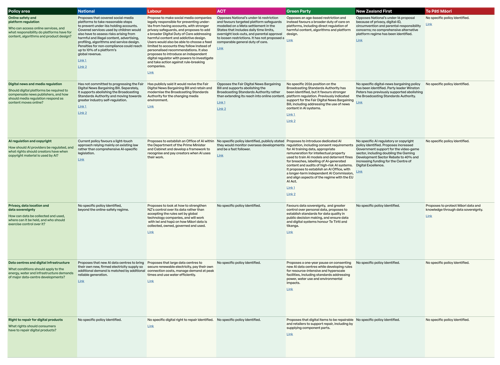
Online safety is likely to be a key area of change. National and Labour both support restricting social-media accounts for under-16s, but Labour would go further with wider duties on platforms. The parties each propose providing the watchdog with powers to enforce safety standards, potentially including substantial penalties for non-compliance. The Greens also favour stronger platform regulation, while ACT prefers targeted protections and parental controls. New Zealand First has raised concerns about a ban’s practicalities including privacy and digital identification concerns.
The parties are taking quite different approaches to digital news and media regulation. Labour would likely revive the Fair Digital News Bargaining Bill and retain and modernise the Broadcasting Standards Authority. National's current Government is moving to abolish the Authority, a position also supported by ACT and New Zealand First, while ACT also opposes mandatory news bargaining.
AI regulation could move beyond New Zealand's current light-touch approach. National would largely retain the current model, while Labour proposes greater central oversight and new copyright rules. The Greens have proposed a more extensive regulatory framework, including rules for AI training data, high-risk systems and AI-generated content.
There is broad agreement that large AI data centres need specific rules, but less agreement on what those rules should be. National focuses on bringing additional electricity generation, Labour on energy and infrastructure requirements, the Greens on tighter consenting and resource-use controls, and New Zealand First on avoiding environmental harm and displacement of electricity needed elsewhere.
The table below summarises the parties' announced positions across six areas of regulation most directly relevant to the digital and technology sector. Each area is framed by the practical regulatory issue it raises. Where no specific 2026 election policy has been identified, we have said so rather than drawing an inference from a party's broader policy position.
This article reflects policies and public positions identified as at 30 October 2026. Policies may change or develop, and further detail may be released during the election campaign.
View our table - click to enlarge
Election day is just around the corner, and we will be watching closely to see which proposals are carried forward, how they develop and what they could mean in practice for the technology sector.
We will continue to share updates and insights through our Beyond the Ballot series. If you have any questions in the meantime, or would like to discuss how any of these proposals could affect your organisation, please get in touch with one of our technology experts.
Special thanks to Tom Hammond and Lucy Reilly for their assistance in writing this article.
Election 2026: The Caretaker Government after election day: what keeps moving?
Election 2026: Competition policy recap
Election 2026: What happens to bills when Parliament dissolves?
Election 2026: Which election tax policies could survive coalition negotiations?


