0
Contact Us

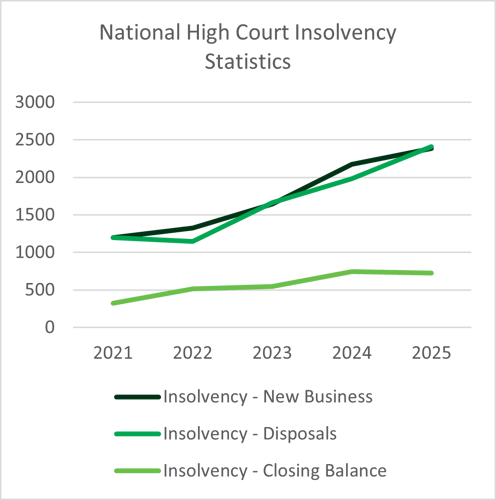
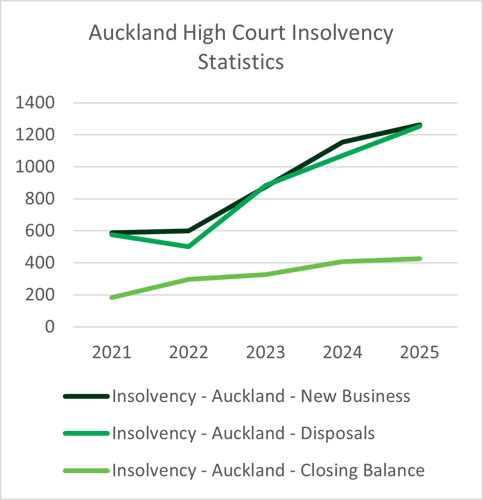
The number of new insolvency proceedings continues to rise, with 2025 seeing an increase of 9.7% from the prior year. Since 2023, the majority of new insolvency proceedings have been filed in Auckland.
 |
 |
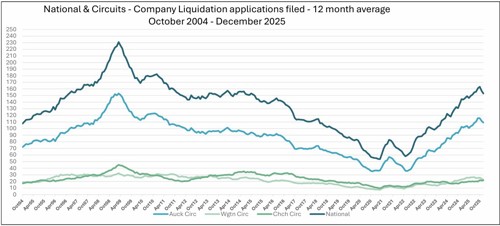
The number of company liquidation applications filed has also increased steadily since about May 2022. This increase is almost entirely driven by new applications in the Auckland Circuit.
The Economic Climate
The increases in insolvency proceedings and liquidation applications are unsurprising given the current economic climate. In the High Court’s Annual Report, Associate Judge Lester noted that the “tight economic conditions which have existed in recent years mean the number of applications for company liquidations and bankruptcies continue to increase”.
Complex cases
Though insolvency processes in New Zealand are relatively streamlined, they can raise thorny issues, likely adding to the increase in proceedings. Three liquidations demonstrate such issues arising:
Though the increasing number of company liquidation applications filed hasn’t quite reached the high levels seen during the Global Financial Crisis in 2008, the steadily growing increase has caught the High Court’s attention. To help manage the growing insolvency caseload, the High Court appointed an additional Associate Judge in August 2025 - Associate Judge Gellert.
Associate Judges deal with civil/commercial and insolvency-related claims and are the primary decision makers in liquidation and bankruptcy applications.
The last two years mark the first time that the total number of Associate Judges has seen a noticeable increase in the last five years, going from consistently having seven Associate Judges across 2021-2024, to having eight in 2025. Adding to this, the appointments of Associate Judges Wild and Malarao (Auckland) and Gambrill (Christchurch), in 2026 mean there are now nine High Court Associate Judges.[7]
This clearly indicates that the Ministry of Justice and the High Court expect that the number of insolvency related matters will rise further, and that there will likely be a longish tail to that work.
Special thanks to Neha Pannu for her assistance in writing this article.
[1] High Court of New Zealand Annual Report 2025, published May 2026.
[2] Maginness v Tiny Town Projects Ltd (in liq) [2023] NZHC 494.
[3] Francis & Dalton v Gross [2024] NZCA 528.
[4] https://www.fma.govt.nz/news/all-releases/media-releases/du-val-group-placed-into-interim-receivership/
[5] https://www.companiesoffice.govt.nz/about-us/what-we-do/our-legislation/du-val-group-statutory-management/
[6] Grant v Arenaalceon NZ Credit Partners, LLC [2022] NZHC 783; Grant v Arenaalceon NZ Credit Partners, LLC [2023] NZHC 3048; Grant v Arenaalceon NZ Credit Partners, LLC [2024] NZCA 366; Arena Alceon NZ Credit Partners, LLC v Grant [2024] NZSC 166; Arena Alceon NZ Credit Partners, LLC v Grant [2024] NZHC 3790; and Arena Alceon NZ Credit Partners, LLC v Grant [2025] NZHC 1360; Arena Alceon NZ Credit Partners, LLC v Grant [2025] NZHC 2959.


