0
Contact Us

Litigation Partner Ben Upton spoke to the NBR about what might be driving the wait time, and the impact of recent reform. Read the article here [paywall].
We expect the time taken to determine High Court cases will lessen with the new rules regime that came into effect on 1 January 2026.[2] However, the effect of that and other changes, such as the introduction of the Auckland Commercial List[3] and the slight increase of judicial appointments, will take time.
2025 saw a 9.8% increase in new claims from the prior year. But the real growth was in civil appeals, which saw a 27.5% increase. The High Court also issued 4128 judgments in 2025, which was an increase of 3.3% from 2024. A higher number of civil judgments drove that increase.
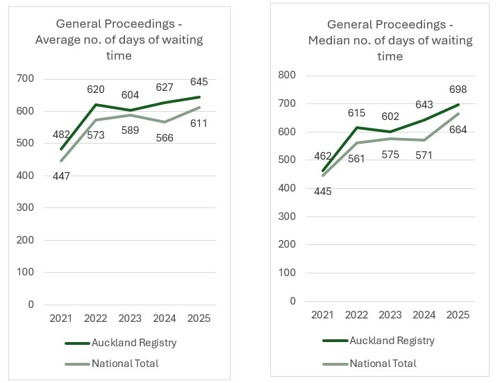
The increased waiting time between a standard case being ready for trial and it being heard by a judge is concerning. After small gains in 2023 / 2024, there is again an upward trend in those statistics, so that the median wait time between being ready for trial and starting the trial in the Auckland High Court is 698 days. This is creeping up to 2 years[4].
The following graphs show the trend since 2021.
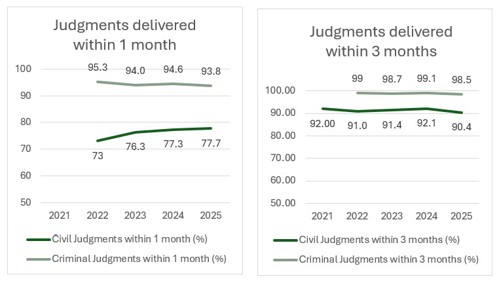
There has been an increase in the number of judgments outstanding beyond a reasonable time (six months). However, those numbers remain low (16 - 21 over the period). Most decisions are made within one to three months of a hearing.
The High Courts are also busy with the increase in insolvency cases. We will address that in a separate article.
The courts and the Government have responded to these challenges by appointing or allowing the appointment of more judges . Particularly Associate Judges who deal with pre-trial and insolvency work.
The new case management processes under revised High Court Rules this year should lead to less delay. This is because there needs to be more focus on the issues and the evidence by the parties and their lawyers earlier in the dispute process. This can assist cases to settle earlier, or for the issues to be rationalised.
The same should apply following a greater use of the Auckland Commercial List for larger cases. The High Court reports favourably on how that List is operating. The Chief High Court Judge says: “While it is relatively early days in the List’s operation, it is already working well, with matters progressing with some speed through the [pre-trial] phases and materially earlier [main trials or hearings] being allocated.” This is good news.
Privately, parties are also frequently advised to look seriously at mediation or other dispute resolution processes outside of the courts, with arbitration or adjudications being the usual options. For larger disputes there are also several international dispute resolution centres that offer their services. With the main regional hubs being Singapore, Hong Kong and Dubai. New Zealand is yet to create such an offering at a commercial level that offers both the hearing precinct and the professional judges.
The court’s new case management system (Te Au Reka) is also soon to commence its roll-out. The rollout of Phase 1 of Te Au Reka in the Family Courts should begin in the Christchurch and Ashburton courts, as well as parts of the national services teams on 23 November 2026. Although this will introduce the new digital case management system for registry and judicial functions only. Other courts will follow later.
An efficient and reliable dispute resolution system is essential to a modern economy. It is a key component to attracting business and investment into New Zealand.
We welcome the responses that the courts and the Government have worked on to improve the civil dispute system that operates in New Zealand. There is a way to go, but there is light at the end of the tunnel.
We will continue to monitor the trends and hope to see dips in the numbers reported next year.
The Chief Justice’s report for 2025, which addresses the wider court offering, including the lower and senior appeal courts, should be available in September 2026.
If you have any questions about the court process or timings for other dispute resolution processes, please contact any of our litigation specialists.
Special thanks to Neha Pannu for her assistance in writing this article.
[1] High Court of New Zealand Annual Report 2025, published May 2026.
[2] https://www.simpsongrierson.com/insights-news/legal-updates/the-countdown-is-on-major-changes-to-high-court-process-just-around-the-corner
[3] https://www.simpsongrierson.com/insights-news/legal-updates/new-commercial-list-set-to-shake-up-commercial-litigation-in-auckland-high-court
[4] 1 year, 11 months and 3 days


